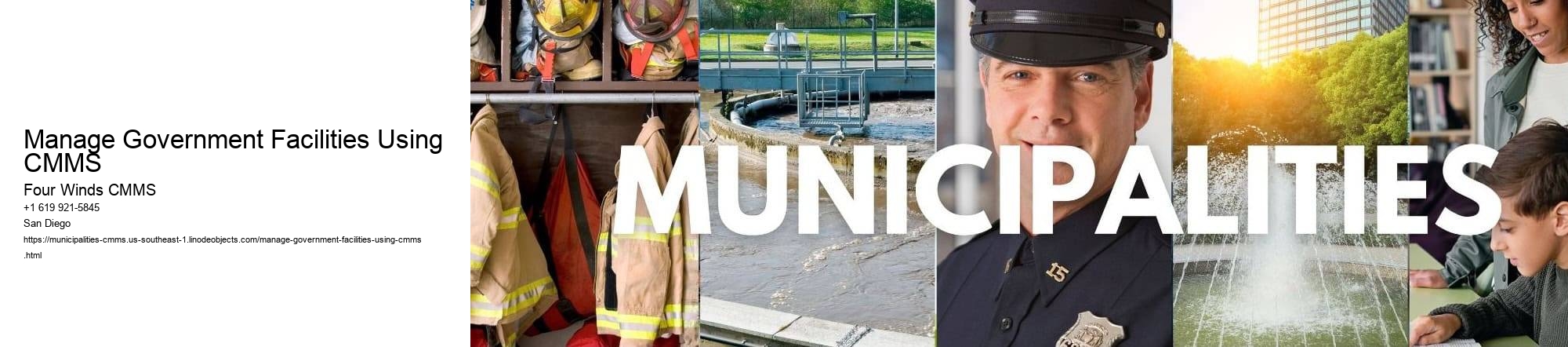
Manage Government Facilities Using CMMS

Manage Government Facilities Using CMMS

City governments today face growing pressure to manage public assets, maintenance schedules, and compliance responsibilities more efficiently than ever before. Municipalities-CMMS software gives public works teams a dependable way to manage maintenance responsibilities. Rather than relying on spreadsheets, paper logs, or disconnected systems, municipalities can move toward a centralized digital approach that supports long-term planning and daily execution.

City governments manage thousands of public assets that require ongoing care and attention. With a Municipalities-CMMS, asset visibility improves across departments. This level of organization helps teams shift from reactive maintenance to preventive maintenance, reducing costly emergencies.

Work order management is a key component of successful municipal maintenance operations. A Municipalities-CMMS simplifies the creation, assignment, and tracking of work orders across departments.

  • Municipal Maintenance Tracking Software USA
  • Across the United States public sector teams trust CMMS software to simplify maintenance.
  • Municipal CMMS For Maintenance Visibility

Field teams benefit from mobile access, allowing updates to be made in real time without returning to the office.

Public sector compliance requires accurate and accessible maintenance records. Accurate documentation reduces compliance risk and administrative burden. Modern Municipal Maintenance Starts With CMMS . Clear documentation improves trust with regulators and stakeholders.

Municipal budgets require careful planning and efficient use of resources. By shifting from reactive repairs to planned maintenance, municipalities can reduce emergency expenses and extend asset life. Data-driven planning improves long-term infrastructure investment.
Municipal operations often involve multiple departments that must coordinate maintenance activities. Unified systems support smoother operations across the organization. This approach improves accountability while allowing each department to maintain appropriate control over its responsibilities.

Municipal environments require solutions built for public sector realities. Ease of use ensures adoption across teams without extensive training. Growth becomes manageable with a flexible CMMS.

Municipal services depend on consistent maintenance practices. Communities benefit when infrastructure is properly managed. Public works teams gain confidence in their operations.


Modern cities require smarter maintenance tools. Future-ready municipalities invest in structured maintenance platforms.

  • Fleet operations benefit from timely inspections and service tracking.
  • Reliable infrastructure depends on consistent upkeep.
Municipal teams gain clarity, control, and consistency through a dedicated CMMS solution.

A job order is typically a job or a task for a customer, that can be scheduled or assigned to somebody. Such an order might be from a client request or produced inside within the company. Job orders may additionally be produced as follow ups to assessments or audits. A job order might be for service or products. A work order should include the following: Requestor Date of request Request information Area Preferred conclusion date Priority degree Job authorized by Description of completed work Job finished by Date of completion In a manufacturing setting, a job order is converted from a sales order to show that work is about to start on the manufacture, building or engineering of the items asked for by the consumer. In a service atmosphere, a work order can be equal to a solution order where the WO records the location, date and time the solution is accomplished and the nature of job that is done. The sort of employees (e. g. job position) may likewise be noted on the WO. A rate (e. g. $/ hr, $/ week) and additionally the complete number of hours functioned and complete worth is additionally shown on the work order. A job order may be a maintenance or repair demand from students, faculty or staff in an university. Orders obtained from outside an organization are typically dispatched (examined and set up) prior to being executed. Work orders may be for preventative maintenance Professionals might utilize a solitary job work order and invoice create that contains the consumer information, defines the work done, lists fees for material and labor, and can be provided to the consumer as an invoice. A work order is an internal paper extensively utilized by projects-based, manufacturing, building and manufacture businesses. A task order may be for items and/or solutions. In a manufacturing atmosphere, a work order is made use of to indicate the beginning of a manufacturing process and will most probably be linked to an expense of product. For this reason, the work order will most likely state: the amount of the item to be manufactured, constructed or produced the amount of basic material to be used, its rate and quantity the sorts of work required, price (per hour or each) and quantity the machine utilisation for each and every equipment throughout the transmitting procedure, its price and quantity In a service atmosphere, a job order can not be the equal to a work or service order where the job order documents the location, day and time the solution is carried out and the nature of solution that was carried out, the job order does not. The type of personnel (e. g. task setting) might additionally be noted at work order. A rate (e. g. $/ human resources, $/ week) and also the complete variety of hours worked and complete value is additionally revealed.

.

Software application as a service (SaaS) is a cloud computing service model in which a company supplies application software to customers while handling the needed physical and software program sources. SaaS applications are accessed using either an internet application or locally-installed software. Unlike other software program delivery models, SaaS separates "the ownership and possession of software from its use." SaaS use began around 2000, and by 2023 was the main type of software application deployment. Unlike many self-hosted software, only one variation of the software exists and just one running system and arrangement is supported. SaaS items normally run on leased infrastructure as a service (IaaS) or platform as a solution (PaaS) systems consisting of hardware and sometimes running systems and middleware, to suit rapid increases in usage while giving immediate and continual schedule to consumers. SaaS clients have the abstraction of limitless computing sources, while economic climate of scale drives down the price. SaaS designs are commonly multi-tenant; generally they share resources between clients for efficiency, yet often they provide a siloed atmosphere for an extra cost. Usual SaaS income models consist of freemium, registration, and usage-based costs. Unlike typical software program, it is rarely feasible to buy a perpetual certificate for a certain variation of the software. There are no details software program advancement techniques that differentiate SaaS from other application growth, although there is commonly a concentrate on regular testing and launches.

.

Property monitoring is an organized strategy to the administration and understanding of all value for which a team or entity is responsible. It might apply both to concrete possessions (physical things such as complex procedure or manufacturing plants, infrastructure, structures or equipment) and to abstract properties (such as intellectual property, goodwill or monetary properties). Possession management is an organized process of creating, operating, maintaining, updating, and getting rid of possessions in one of the most cost-effective way (consisting of all prices, dangers, and performance features). Concept of possession monitoring mostly manages the routine matter of enhancing, maintaining or in various other situations guaranteeing the economic and resources worth of a possession gradually. The term is commonly made use of in design, the business globe, and public facilities industries to make sure a collaborated method to the optimization of expenses, risks, service/performance, and sustainability. The term has actually traditionally been utilized in the financial field to describe people and companies who handle investments in behalf of others. Those include, as an example, investment managers who take care of the assets of a pension plan fund. The ISO 55000 collection of standards, created by ISO TC 251, are the global standards for Property Administration. ISO 55000 supplies an introduction and requirements spec for a monitoring system for asset administration. The ISO 55000 standard defines a property as an "product, thing or entity that has potential or actual value to a company". ISO 55001 specifies requirements for an asset monitoring system within the context of the company, and ISO 55002 offers guidelines for the application of a property management system, according to the needs of ISO 55001.

.

Public works are a wide category of facilities projects, funded and obtained by a government body for leisure, employment, and health and wellness uses in the higher neighborhood. They consist of public structures (courts, schools, and medical facilities), transport infrastructure (roads, railways, bridges, pipelines, canals, ports, and airport terminals), public rooms (public squares, parks, and coastlines), public services (supply of water and therapy, sewer therapy, electrical grid, and dams), environmental protection (drinking water defense, soil disintegration decrease, wildlife habitat conservation, preservation and repair of forests and wetlands) and various other, usually long-term, physical assets and facilities. Though frequently compatible with public infrastructure and public funding, public works does not necessarily lug an economic component, thus being a more comprehensive term. Construction might be embarked on either by straight employed work or by a personal operator. Public works has been urged since antiquity. The Roman emperor Nero encouraged the construction of various framework jobs throughout widespread deflation.

.

A town is normally a single management division having business status and powers of self-government or jurisdiction as given by national and local laws to which it is subordinate. The term district may likewise imply the governing body of a given district. A municipality is a general-purpose management class, in contrast to a special-purpose area. The English word is originated from French municipalité, which subsequently derives from the Latin municipalis, based on words for social contract (municipium), referring originally to the Latin neighborhoods that supplied Rome with soldiers in exchange for their very own unification into the Roman state (giving Roman citizenship to the residents) while permitting the communities to preserve their own city governments (a limited autonomy). A district can be any kind of political jurisdiction, from a sovereign state such as the Principality of Monaco, to a small town such as West Hampton Dunes, New York. The region over which a community has jurisdiction might encompass: only one inhabited area such as a city, town, or village a number of such places (e. g., very early territories in the U. S. state of New Jersey (1798–-- 1899) as towns regulating several towns, districts of Mexico, districts of Colombia). only parts of such locations, in some cases districts of a city, such as the 34 districts of Santiago, Chile.

.

About San Diego

Frequently Asked Questions

Municipalities-CMMS is designed specifically for city governments and public works departments that manage public assets such as roads, utilities, fleets, parks, and facilities. Unlike generic CMMS tools, it supports municipal workflows, compliance requirements, and multi-department coordination, making it better suited for public sector operations.

Municipalities-CMMS can be used by public works departments, water and wastewater teams, fleet management, parks and recreation, facilities management, utilities, and city infrastructure teams. Multiple departments can work within the same system while maintaining clear responsibility and visibility.

By enabling preventive maintenance and better planning, Municipalities-CMMS helps municipalities avoid costly emergency repairs and unplanned downtime. Tracking labor, parts, and asset performance also allows city leaders to make informed budget decisions and extend asset life.

Yes, Municipalities-CMMS keeps detailed records of inspections, maintenance activities, and service history. These records help municipalities meet compliance requirements related to safety and regulatory standards and make audit preparation easier and less stressful.

Municipalities-CMMS is designed with simplicity in mind. Field technicians can access work orders, update tasks, and record maintenance activity using mobile devices, reducing paperwork and improving accuracy without requiring extensive training.

Implementation is typically straightforward and faster than traditional enterprise systems. Most municipalities can begin using Municipalities-CMMS quickly without complex IT infrastructure, allowing teams to see benefits in a short time.

Yes, Municipalities-CMMS is ideal for small to mid-sized municipalities that need powerful maintenance management without unnecessary complexity. The system is scalable, meaning it can grow alongside municipal operations as asset portfolios and teams expand.